OR directors
Know which cases need attention.
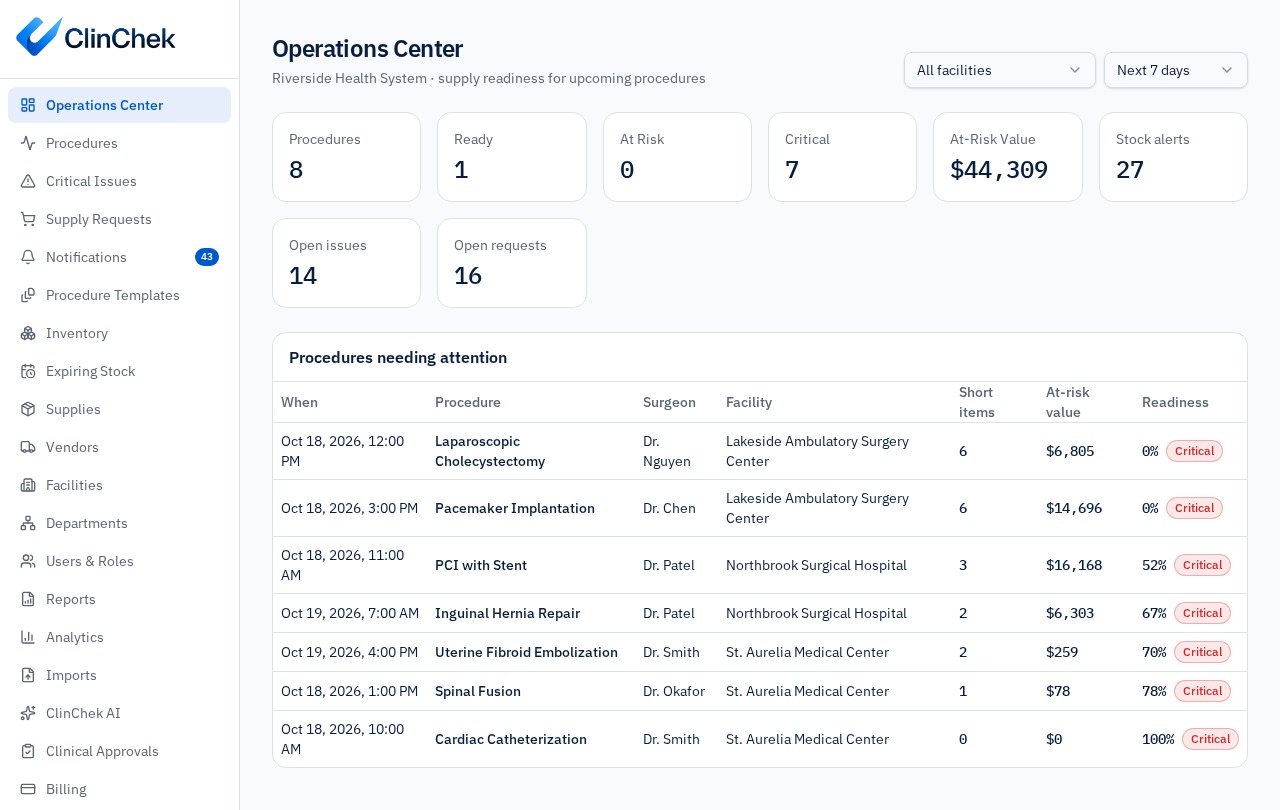
- Review upcoming procedure readiness by facility and date
- See short items and prioritize at-risk cases
- Use readiness reports to focus operational discussions

Procedure-readiness coordination
Know what's needed. Know what's ready. Fix what's missing.
The procedure-readiness coordination layer that helps hospitals identify missing supplies before a case, assign responsibility, and verify resolution — without replacing their existing systems.
Six questions. Get an immediate gap summary and practical next steps—no email or account needed.
Actual ClinChek screen · illustrative demo records, not patient data or customer results
Detect
Compare procedure requirements to recorded inventory.
Alert
Surface at-risk procedures before the day of surgery.
Assign
Route shortages to the right supply-chain owner.
Resolve
Transfer, substitute, or expedite missing items.
Confirm
Clinical teams see a clear Ready status.
Works alongside your existing EHR, ERP and inventory systems — no integration required to start.
Start with the data you have
Start with manual setup and CSV uploads—without connecting your EHR or ERP. ClinChek uses the records you enter, not an automatic feed from systems you haven’t connected.
Add facilities, supplies and vendors. Enter upcoming procedures and build templates listing the supplies and quantities each procedure needs.
Upload vendors, supplies and inventory using CSV templates, or enter them manually. Preview uploads and correct validation errors before importing.
Compare procedure requirements with recorded stock. Create supply requests and issues, assign owners, track progress and route substitutions for clinical approval.
Assign an owner to keep stock and procedure records current. CSV uploads do not schedule background synchronization. Readiness is only as current as your last update, and ClinChek does not write back to your EHR or ERP without a separately implemented connection. Import templates and validation rules determine whether an upload adds or updates records.
Built for the people coordinating procedure readiness.
Know which cases need attention.
Turn shortages into owned actions.
Keep clinical decisions with clinicians.
Interoperability, with clear boundaries
CSV imports and the organization-scoped ClinChek API are available today. Epic, Cerner, Oracle, Workday and Infor connections require evaluation and custom implementation; they are not live, certified or out-of-the-box ClinChek connectors.
Read procedures, readiness, inventory, supplies, vendors, issues and supply requests. Create issues and supply requests. Administrators manage revocable API keys scoped to their organization.
The connection registry tracks administrator-entered details and status. A “Connected” label alone is not proof of a working vendor data feed. Vendor authorization, mapping, testing and monitoring are separate implementation work.
Start manually. Evaluate connections around your workflow—not the other way around.
Discuss your integration needsThe value of readiness
Model recovered operating-room time and staff coordination time using your own assumptions. All figures below are estimates, not measured ClinChek results.
cases / month
minutes / case
USD / minute
staff minutes / case
Illustrative starting assumptions: 8 cases per month, 45 OR minutes and 30 staff minutes per case, at $40 per OR minute. The $40 value is an example, not a current national average. Count each case once; for cancellations, include only OR time that would otherwise go unused.
Modeled gross OR-time value / month
$14,400
Cases avoided × recovered OR minutes × cost per minute
Recovered capacity is not guaranteed cash savings or additional revenue. This is not net ROI: subscription, implementation and other costs are excluded. Staff hours are reported separately and not added to OR-time value, avoiding double counting.
Published context: Childers & Maggard-Gibbons reported an average inpatient OR accounting cost of $37.45 per minute in California hospitals for fiscal year 2014. This historical, regional estimate is not a current national rate or marginal cash saving. Read the study · JAMA Surgery, 2018
A meaningful pilot compares supply-related delays and cancellations before and after ClinChek, confirms recovered OR minutes, and records staff coordination time. No verified ClinChek pilot outcomes are published here yet.
Take the OR supply readiness checklist to your next team huddle: procedure requirements, stock availability, clinical review and final handoff. One page. No email or account required.
Download OR readiness checklist (PDF)